
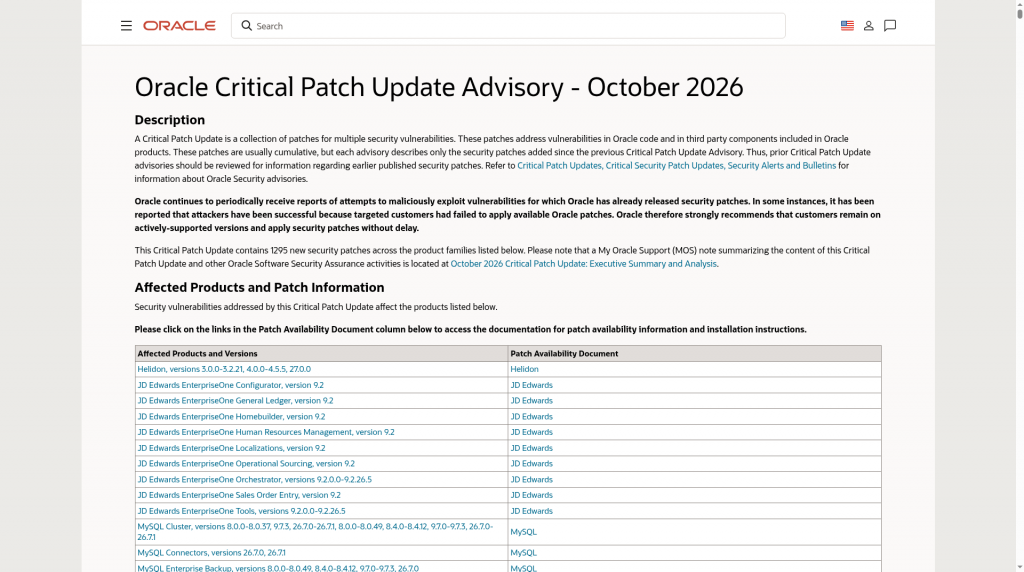
Oracle did not whisper.
On October 20, 2026, Oracle released its October Critical Patch Update and told customers what it always tells customers, only louder this time: stay on supported versions, and apply the security patches without delay. Attackers keep trying the holes Oracle has already patched. They succeed when the patch is sitting in a queue instead of in the system.
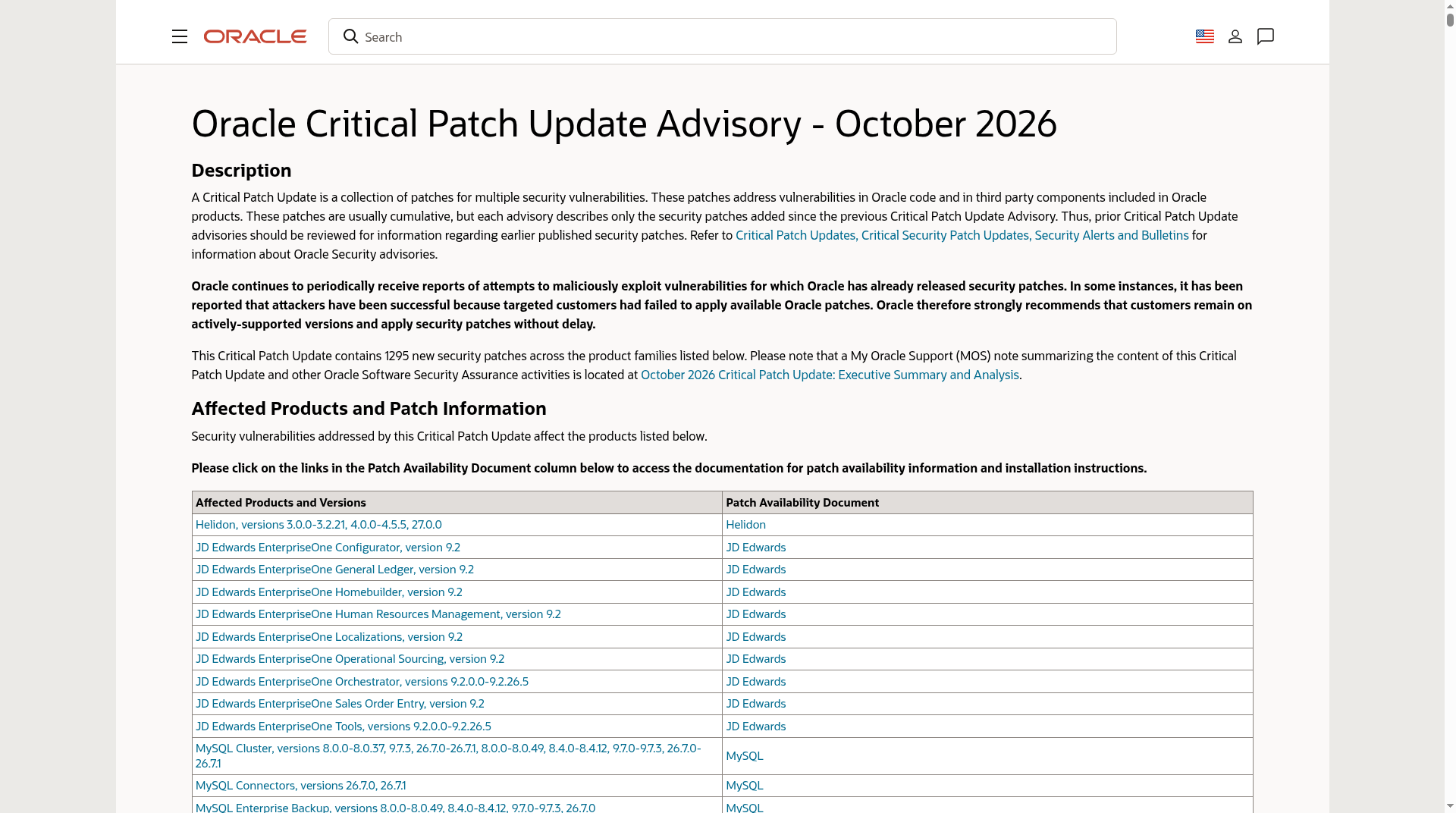
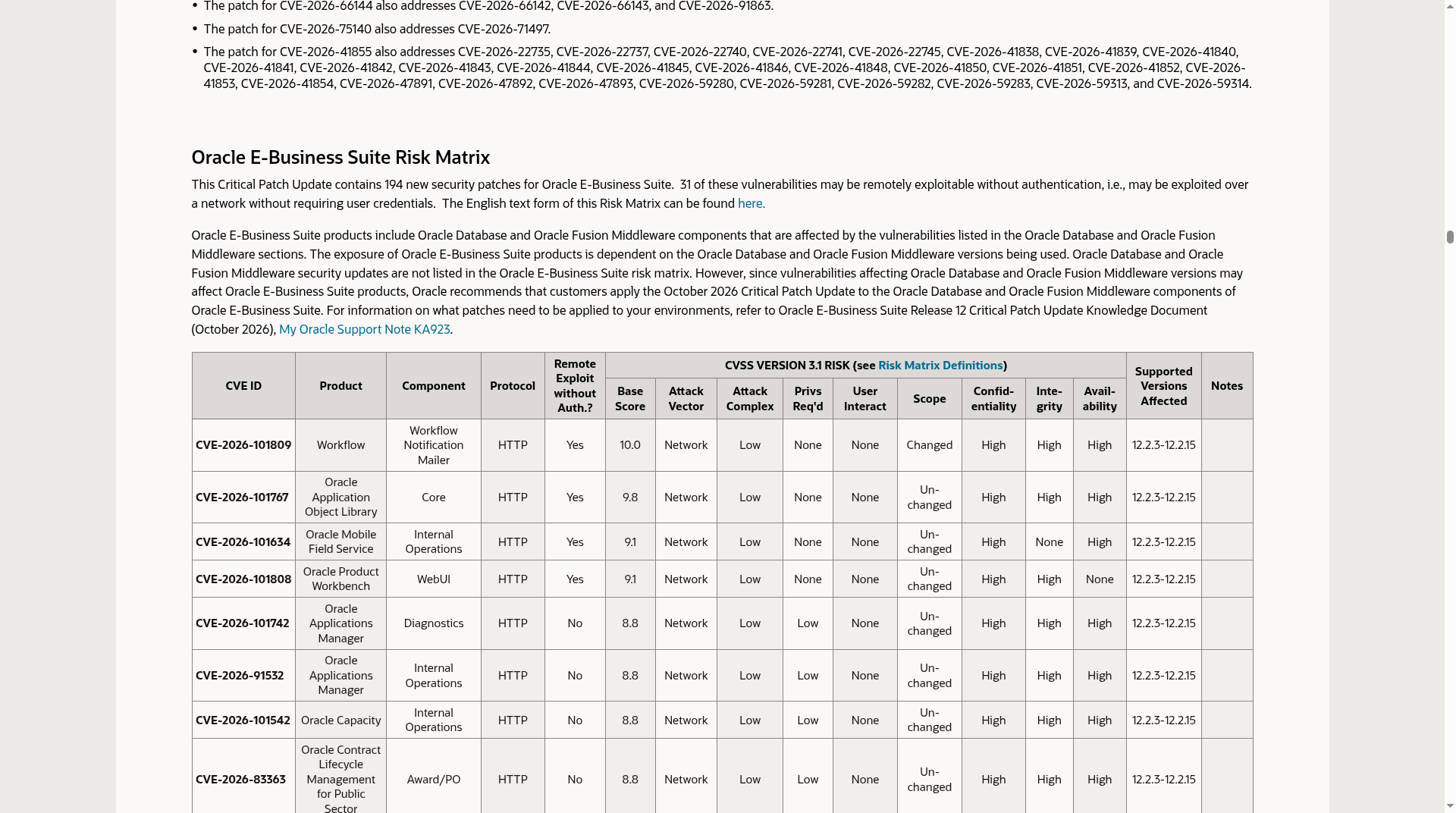
Inside that same quarterly release was a problem with a name and a score. CVE-2026-101767. Oracle Application Object Library, Core, in E-Business Suite 12.2.3 through 12.2.15. Remotely exploitable without a login. CVSS 9.8. Successful attacks can take over that component.
Researchers later spelled out what Oracle’s matrix implies in the field: the Thin Client Framework servlet — /OA_HTML/AppsTCFServer — could be reached without credentials. Unauthenticated SQL as the APPS user. A path from there toward the application host. The interim advice matched what every careful EBS shop already suspected: pull that servlet out of the URL firewall allowlist, lock the web tier down to people who should be there, and patch.
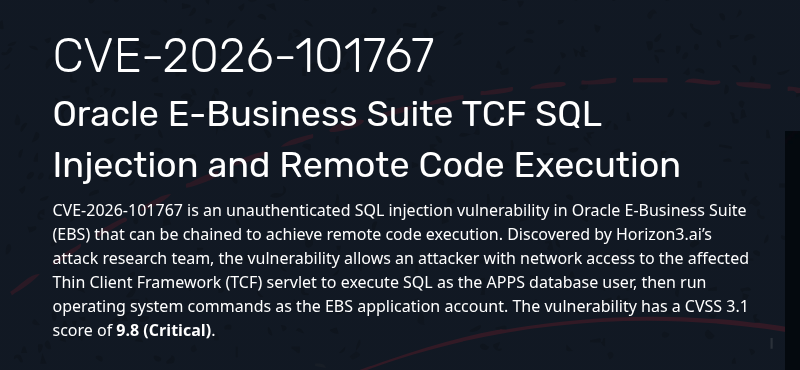
By the end of October, public agencies were repeating a worse sentence. Open-source reporting indicated the issue was being exploited in the wild.
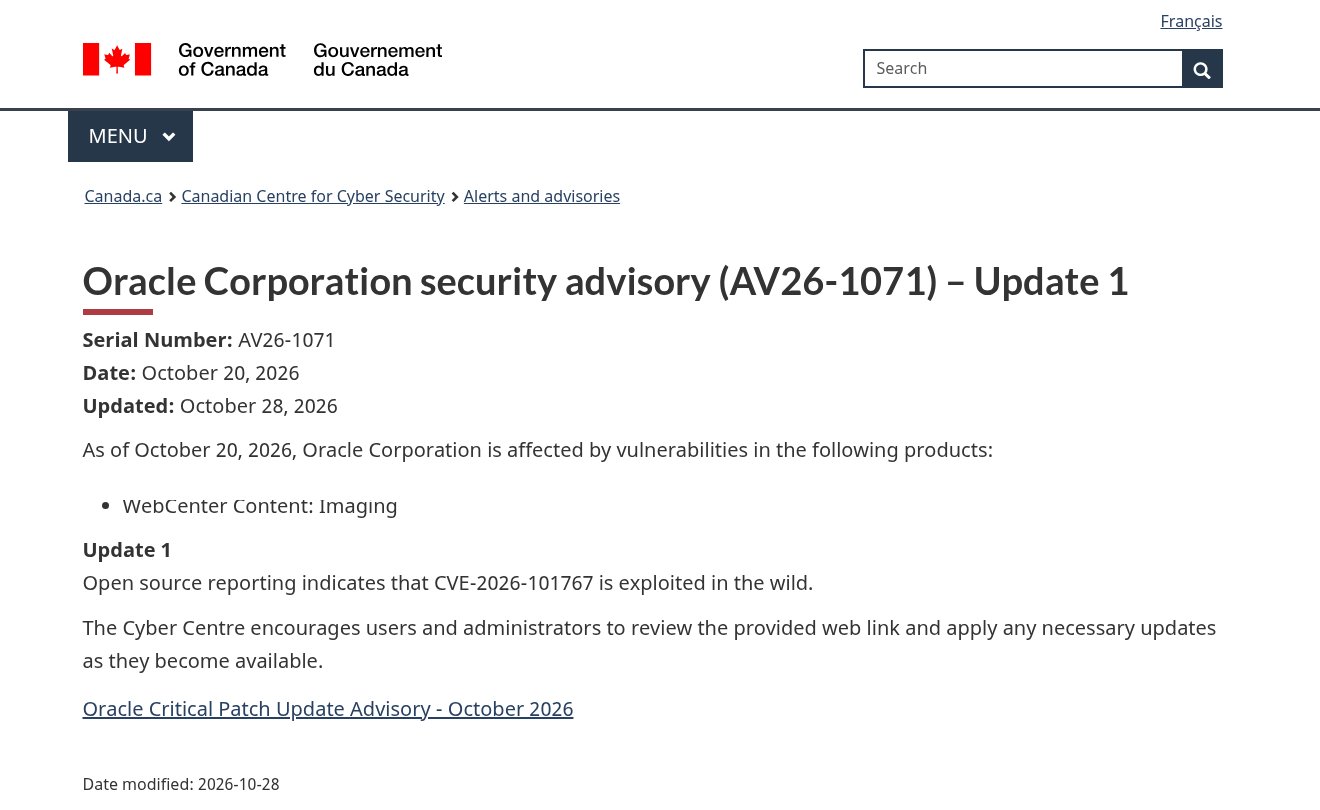
That is not a “we should get to the CPU next quarter” note. That is an emergency inside the periodic process Oracle already expects you to run.
The part nobody puts on a slide
I run a live Oracle E-Business Suite Vision environment so clients can see the real product. Not a slide of a dashboard. The thing itself. Payroll screens. Command Centers. The workflow they will argue about in a conference room next month.
I do not have a bench of DBAs waiting to disappear into an adop cycle for a day. A proper EBS CPU is database, applications, Fusion Middleware, WebLogic, Java, cutover, clone, and proof. It is hours. It is also the kind of work that used to mean I either hired a crew I do not have, or I left the demo on last quarter’s patches and hoped.
Hope is not a control.
Last year I already learned that the hard way. An EBS environment I was running was taken down — before I started giving systems integration the leeway to do what it needed to do to protect what I host. I am not interested in repeating the lesson.
Without this operating model, I would be out of the game, or at least at extreme risk. I could not honestly put a Vision instance in front of a client and call it safe. Not with a 9.8 on the front door and a CPU I could not apply alone.
What I built instead of a bench
I implemented Oracle EBS the way I implement it for clients: documented, repeatable, and honest about where the secrets live. Then I set up Claude CLI agents with the environment’s runbooks, rules, and access — not as a chatbot that answers “how do I patch,” but as operators that already know the host, the file systems, the apply order, and the rules.
Grok sits above that work as the technical manager. It keeps the sequence. It reads what Claude CLI just did. It translates a failure into a decision I can actually make. It is forbidden from the sloppy shortcuts: no credentials in chat, no apply without a backup, no guessing at a prompt it does not understand, no lifting a security control because the script “probably” worked.
I have one job in that model. I approve steps.
When the agents need a vault secret, a recovery change, a restart, or permission to take a fence down, I get a short request. I sign it with a passkey. The handoff resumes. I signed nine contained decisions on this CPU. I do not pretend I can staff a 14-hour window by myself. I stay the change manager.
What happened when the October CPU landed
We treated the emergency and the quarterly patch as the same change, because they are.
The October 2026 CPU was downloaded and staged first. Nothing was installed until a backup existed and I had signed the apply.
The download was the first proof of the model. Oracle no longer wants a password sitting on the server. It wants a download token that dies in an hour. Grok Bot coordinated the minting of that token — a person completed the MFA sign-in — then wrote it as a new version of a secret in OCI Vault. The value never passed through chat or a screenshot. Claude pulled the secret and ran Oracle’s own download on the EBS server. A short-lived copy on the server was shredded after each download. Thirty-seven patch files, 6.3 GB, arrived over four runs, each one using a token that expired within the hour. I approved the vault use. The value itself stayed in the vault.
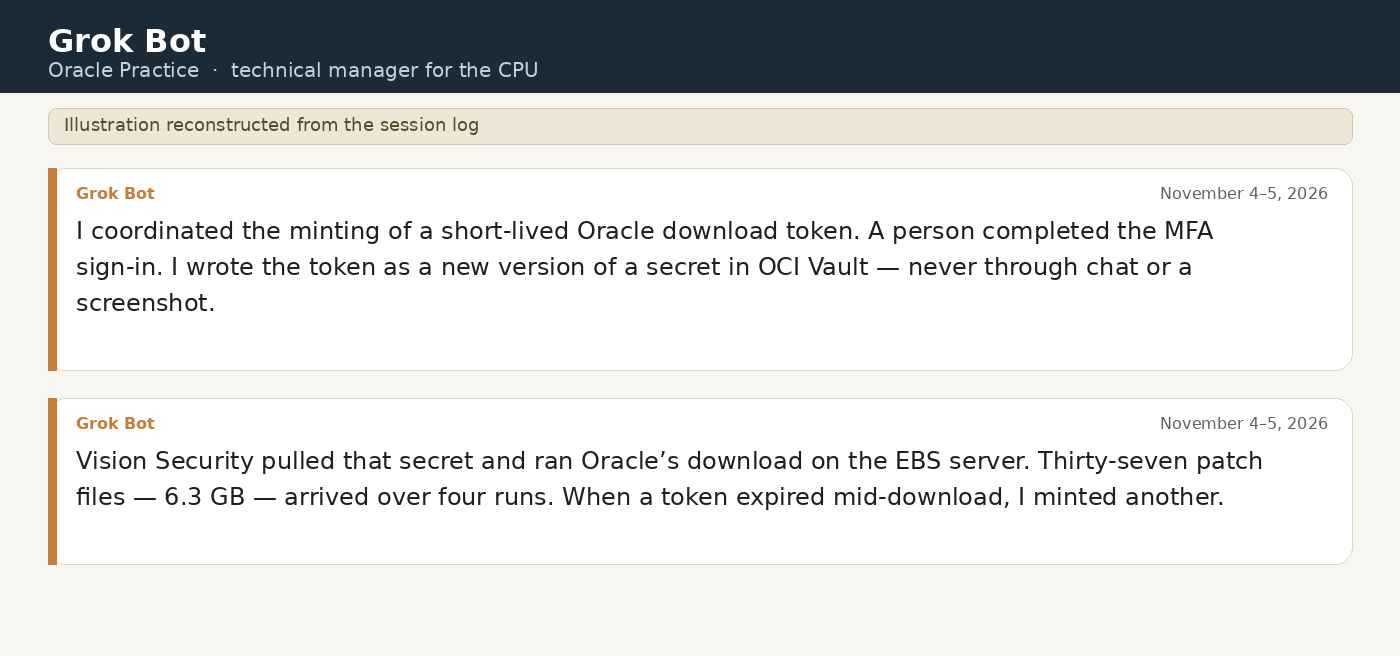
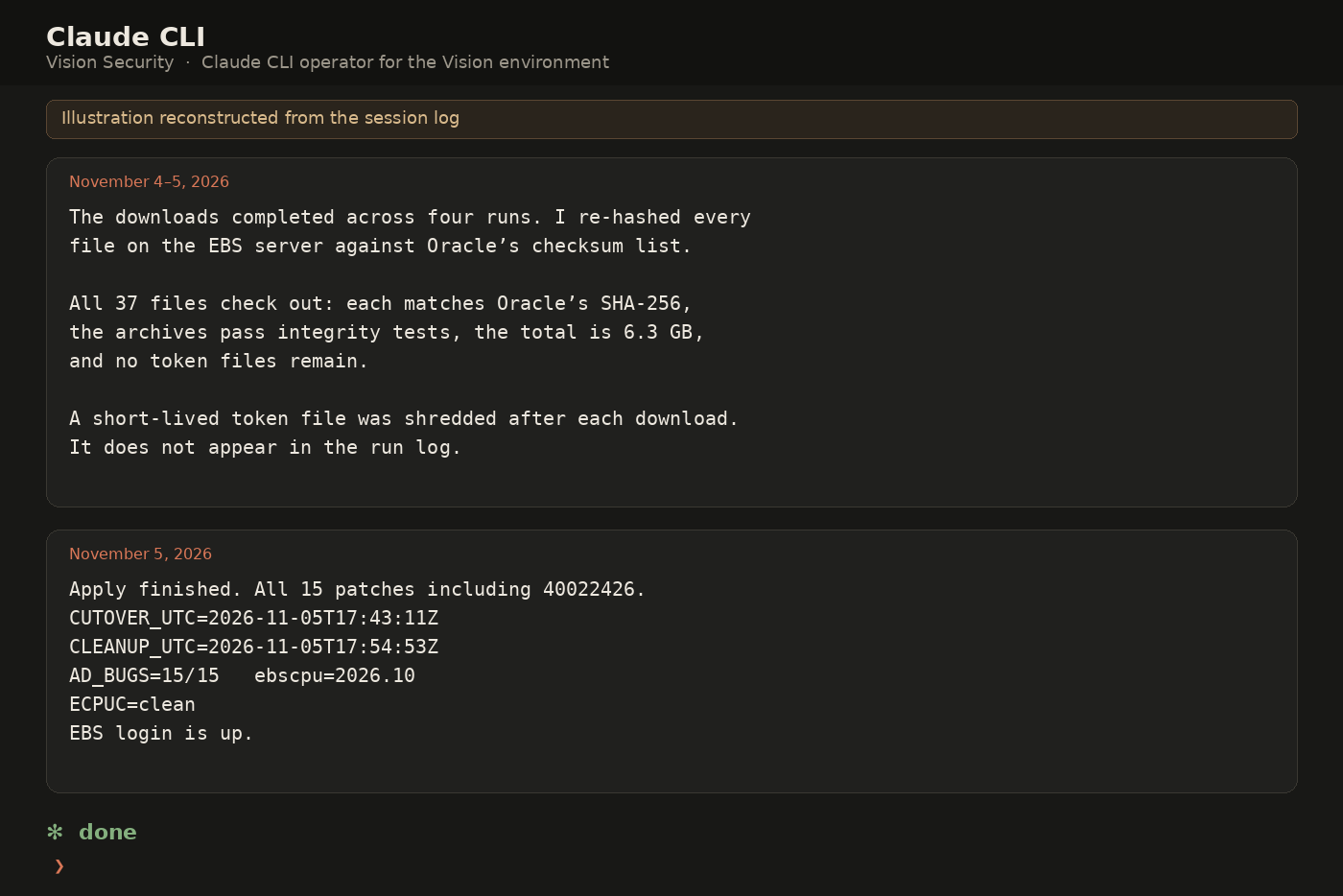
Claude CLI did the host work. Grok kept the run from drifting. I approved the gates.
The apply was not cinematic and clean. Prepare failed because a custom product lived on one file system and not the other — the dual-file-system surprise every EBS person has met at the worst possible time. Twice the run stalled at an Oracle prompt the script did not recognize. The fix was to make it stop immediately on any prompt it does not recognize, instead of waiting or guessing yes. A restart check mistook leftover processes for a running application after a clean stop, and halted with EBS down until a fix was signed. After cutover, AutoConfig failed because Oracle’s online-patching seed-data copy had left 8,743 of about 10,300 profile option definitions invisible in the live edition — an Oracle-side defect, not a script bug. Claude traced it to a stale seed copy, dry-ran an additive repair with a rollback, and I signed that fix too. Each time, Claude CLI diagnosed it. Grok brought me the decision. I signed the contained change. The run continued.
On November 5, 2026, the CPU was in. The new file system was live just after 12:43 p.m. Eastern. Login came back. Oracle’s own bug table showed all 15 applications patches, including the security patch behind CVE-2026-101767. The EBS and Java CPU checkers were clean.
The extra fence we had put in front of AppsTCFServer stayed up on purpose until that proof existed. Only then did I approve taking it down. From the outside, the servlet no longer answered with a proxy denial. It answered like EBS: not authorized, and a TCF request requires a valid session. That is the difference between “we hid it” and “we patched it.”
The Vision environment is up. I can keep using it to present demonstrations to clients without pretending the October emergency was someone else’s problem.
Why this is the story, not the script
A consultant without a bench used to have two choices when Oracle published a 9.8: go dark, or stay exposed. Systems integration — the way I have wired this implementation, set up the Claude agents with its runbooks, and put Grok in the technical manager’s seat — is the third choice.
The agents did the labor. I kept the authority. The demo stayed in the game.
AI is a tool. People remain responsible.
If you are an Oracle E-Business Suite shop that cannot staff every CPU like a factory, and you still need the system safe enough to show — or safe enough to run — reach out.
David Norton
David Norton Consulting
sales@davidnortonconsulting.com
+1 207 741 8291