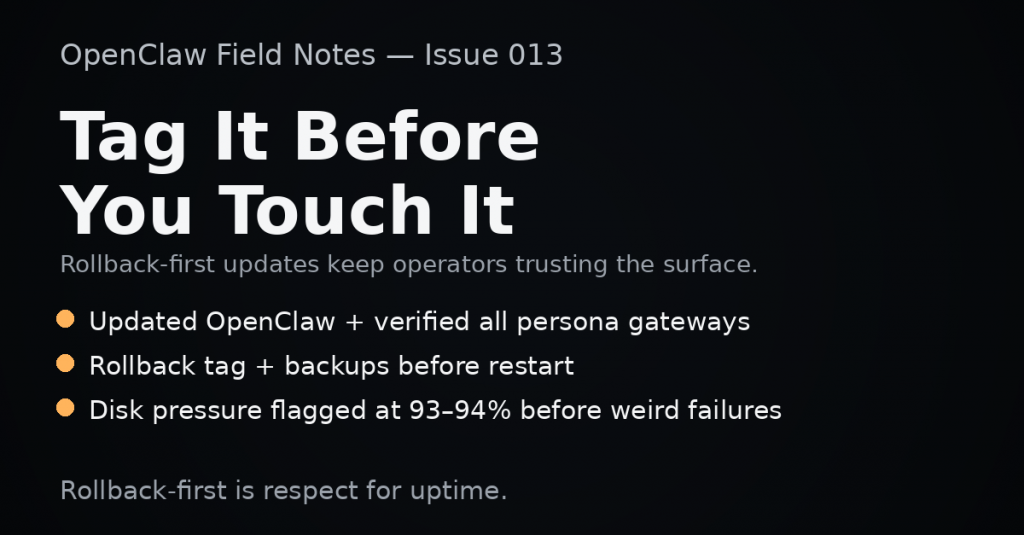
OpenClaw Field Notes — Issue 013
Tag It Before You Touch It
Shipped 01 — Platform
OpenClaw updated cleanly — moved the whole stack forward to a current release and verified every persona gateway came back clean.
Shipped 02 — Rollback
Rollback discipline enforced — created a rollback tag + backups first, so the update was reversible instead of a leap of faith.
Shipped 03 — Capacity
Disk pressure surfaced early — caught root volume usage at 93–94% and raised it as an operator risk before it became downtime.
TL;DR
This week was a maintenance window week: the kind where everything seems fine until it suddenly isn’t.
We updated OpenClaw safely (rollback-first), verified every persona gateway and the portal auth surface, and flagged disk pressure before it could turn into random failures.
Content Note
This is what “getting good” looks like. Backups, tags, verification steps, and boring checklists — because that’s what keeps upgrades from becoming outages.
What We Shipped / Moved Forward
1) OpenClaw Update: The Maintenance Window That Didn’t Become a Fire Drill
What was broken: we were behind on upstream changes, with local customizations mixed into the runtime. That’s the recipe for updates that either fail halfway or succeed but leave the system subtly different.
What changed: we updated the platform in a planned window, carried forward the safe local deltas, and deliberately deferred the changes that conflicted too deeply with upstream internals.
Why it matters: “updated” only counts if the system still behaves the same for operators and clients the next morning.
2) Verification: If You Don’t Check It, You Don’t Know It
What was broken: the risk wasn’t the build — it was the surfaces: each persona gateway, and the portal auth redirect path that operators rely on.
What changed: we verified the personas were live and the portal auth flow responded normally after restart.
Why it matters: reliability is a habit. Verification turns “I think it’s fine” into “we checked the surfaces users actually touch.”
3) Disk Pressure: The Kind of Problem That Makes Everything Weird
What was broken: root disk utilization climbed past the safety threshold. At that point, the failures aren’t dramatic — they’re random: restarts fail, logs stop writing, caches corrupt, and you lose hours chasing ghosts.
What changed: we raised the alert, scoped initial suspects (logs, inbound media, build artifacts), and queued a cleanup pass before it hit the “everything breaks” zone.
Why it matters: operators don’t need perfect systems. They need systems that fail predictably, not systems that fail because the disk is full.
Field Notes
- Rollback-first is respect for uptime. A tag + backup is cheaper than a postmortem.
- Verification is part of shipping. If you didn’t check the surface, you didn’t ship it.
- Capacity issues are reliability issues. Disk pressure turns clean problems into unpredictable ones.
- Not every local tweak is worth preserving. Sometimes upstream wins; document the delta and move on.
Principle of the Week
Tag it before you touch it.
The best maintenance windows are the ones you can undo.
- Finish the disk cleanup pass and add a standing “capacity check” rhythm
- Document the deferred local changes so we can re-evaluate them against current upstream
- Keep hardening operator surfaces (messaging + portal + runbooks)
Work With Us
If your platform upgrades keep turning into outages because rollback, verification, or capacity isn’t engineered in — reach out.
OpenClaw Field Notes is our weekly execution log — written for prospects and partners. Outcomes and momentum, without sensitive internals.
AI is a tool. Humans remain accountable.