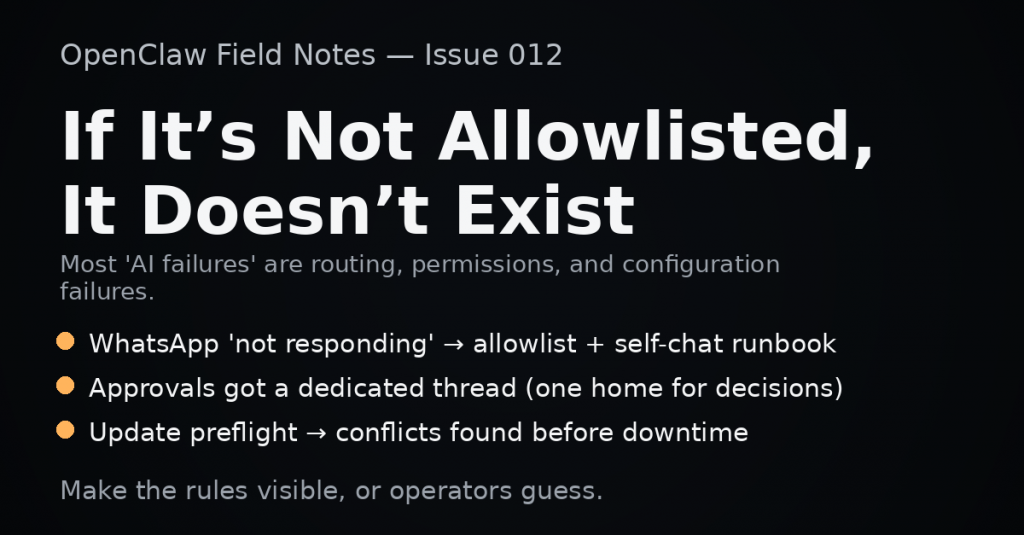
OpenClaw Field Notes — Issue 012
If It’s Not Allowlisted, It Doesn’t Exist
Shipped 01 — Messaging
WhatsApp “silence” debugged — documented the two common failure modes (allowlist-only routing + self-chat disabled) so operators can diagnose in minutes, not hours.
Shipped 02 — Determinism
Approvals got a dedicated thread — created a clean home for watcher drafts + approvals so decisions don’t vanish in the scroll.
Shipped 03 — Maintenance
Update preflight done safely — rehearsed an OpenClaw update, confirmed it would conflict with local changes, and packaged a rollback-first maintenance plan.
TL;DR
Nothing “broke” in a spectacular way. It just stopped responding in the way humans experience as broken.
This week was about leaving fingerprints: making silent failure modes legible, giving approvals a deterministic home, and doing the boring preflight work before touching anything live.
Content Note
We’re documenting what we’re getting good at. Not “AI thought leadership.” This is where things didn’t work the way you expected — and the small operator moves that made it reliable again.
What We Shipped / Moved Forward
1) WhatsApp: When “Not Responding” Isn’t an Outage
What was broken: a message would send, and nothing would come back — the worst kind of failure because it feels like the system is ignoring you.
What changed: we documented a quick operator checklist: (1) allowlist-only routing means unknown numbers get ignored, and (2) self-chat is disabled so messaging the linked WhatsApp account won’t trigger a reply.
Why it matters: most messaging “bugs” are really policy. If the rules aren’t visible, operators will waste time debugging the wrong layer.
2) Approvals: Give Decisions a Home
What was broken: watcher drafts and approvals would land wherever the conversation happened to be, which makes “did anyone approve this?” a recurring question.
What changed: we created a dedicated thread for watcher drafts + approvals, so reviews happen in one place and context stays attached to the decision.
Why it matters: determinism beats willpower. If approvals don’t have a predictable home, they become a latency tax on everything else.
3) OpenClaw Update: Rehearse Before You Restart
What was broken: the assumption that “just update” is a single command. In reality, local changes + upstream drift can turn updates into manual merge work.
What changed: we did a safe rehearsal in isolation, confirmed conflicts early, and packaged the local deltas so a maintenance window could be planned with rollback-first discipline.
Why it matters: downtime isn’t caused by updates — it’s caused by surprises. Preflight turns surprises into decisions.
Field Notes
- Silence is a policy failure until proven otherwise. If a system ignores you by design, it will look like a bug.
- Determinism scales. A single place for approvals is cheaper than 20 messages asking where the approval went.
- Rehearsal beats heroics. If an update might conflict, find out before you’re in the maintenance window.
- Make the rules visible. Operators can’t follow policies they can’t see.
Principle of the Week
If it’s not allowlisted, it doesn’t exist.
People will trust the system more when it fails loudly with a reason than when it fails quietly with no signal.
- Run the OpenClaw update in a planned window (with rollback ready)
- Tighten messaging diagnostics so “ignored by policy” is obvious to operators
- Keep moving more workflows into “one place, one thread, one source of truth”
Work With Us
If your execution keeps stalling on routing, permissions, or invisible policy rules — reach out.
OpenClaw Field Notes is our weekly execution log — written for prospects and partners. Outcomes and momentum, without sensitive internals.
AI is a tool. Humans remain accountable.