Today I was driving to pick up farm equipment and realized: I’m building a production AI system from the car.
Not email. Not texting. Actual system design. Real decisions. Real progress. By voice, hands-free, while watching the road.
This isn’t “working on a laptop in traffic.” I’m talking to AI the same way I’d talk to a teammate sitting in the passenger seat — except they don’t get tired, they don’t lose the thread, and they can hold the entire system in their head while I focus on driving.
Right now:
- Teams → operations
- Discord → engineering threads and approvals
- WhatsApp → real-world coordination
No keyboard. No screen juggling. Just conversation.
The interface to building is becoming talking.
What it actually looked like
Driving. Watching the road. Spotify on. Talking through decisions and moving things forward.
I missed a couple turns. The trip took maybe 15 minutes longer than it should have.
And honestly? That’s fine.
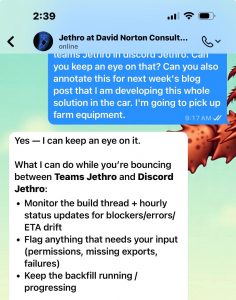
The work didn’t stall. I didn’t have to wait until I got back to a desk. I didn’t lose the thread or have to reconstruct where I was. I just kept going — safely, continuously, without burning the mental overhead of stopping and starting again.
No reset. No ramp-up. Just continued.
The real constraint
The problem isn’t lack of tools. It’s fragmentation.
My work brain isn’t in one place. It’s spread across Teams, Discord, and WhatsApp — and that’s true for most people now.
The hard part isn’t having the conversations. It’s maintaining continuity across all of them:
- what was decided
- where it was said
- what needs to happen next
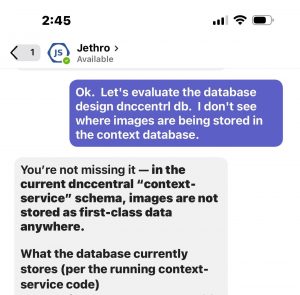
Without duplicating everything everywhere. Without letting context bleed into places it doesn’t belong.
That’s where things break down. Not at the conversation level — at the memory and handoff level.
What I’m building
Not one bot that lives everywhere.
A system where continuity is maintained across channels — without reposting everything and without context leaking where it shouldn’t. The goal is one brain, multiple channels. Context linked behind the scenes. Access strictly separated between assistants with hard boundaries between them.
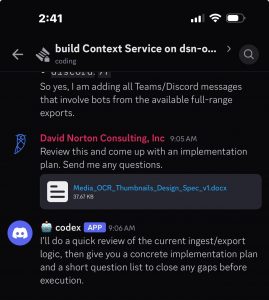
That last part matters more than anything else. If you don’t solve privacy and isolation, this doesn’t work in the real world. It becomes a liability instead of a tool.
Why this matters on a farm
Farm work doesn’t wait and it doesn’t care about your calendar.
Equipment pickups, weather windows, repairs, supply runs — none of it fits a tidy schedule. You don’t get long, clean blocks of uninterrupted focus time. You get fragments. Thirty minutes here. An hour in the truck. A gap between tasks that disappears faster than you expect.
That’s where everything used to break: I’ll deal with that when I’m back at my desk.
Except by the time you’re back at your desk, the thread is cold. You’ve lost the context. You spend 20 minutes reconstructing what you were thinking instead of actually moving forward.
Now it’s: we can move this forward right now.
That shift — from deferring to continuing — is the whole thing.
What’s actually changing
The old model: wait until you’re stationary, reconstruct your context, burn time getting back into it, lose momentum.
The new model: keep living your life, keep the work moving by voice, let AI handle the remembering.
This isn’t about being always-on. It’s about not losing ground every time life happens.
AI doesn’t give you more hours. It makes the in-between hours count.
Today I was driving, missed a couple turns, and still moved a real system forward.
That’s not a demo. That’s how AI is helping me farm.
Next: why different bots for Teams, Discord, and WhatsApp — and what goes wrong when you use just one.