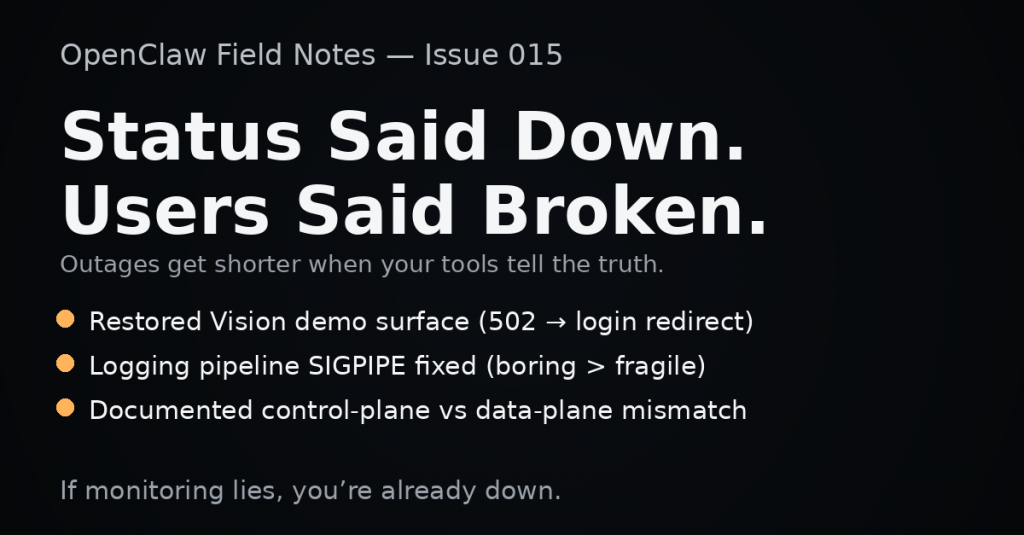
Shipped 01 — Vision Demo
Demo surface + interface options delivered — restored the Vision web tier and presented implementation paths for EBS Absences → Outlook Calendar O365 + Common Application Calendar (CAC).
Shipped 02 — Customer Ops
ADP + benefits fixes moved forward — advanced open enrollment and life insurance rate work with deployable artifacts (change docs + code packages).
Shipped 03 — Control Plane
Status signal reconciled — captured the control-plane vs data-plane mismatch so incidents get shorter and operators can trust what they see.
TL;DR
This week focused on real customer-facing ERP work — stabilizing the Vision demo surface, advancing EBS→O365 integration planning, and shipping ADP/benefits fixes with deployable artifacts.
The bigger pattern: delivery workflows that stay reliable even when the operator isn’t in front of the admin console.
What We Shipped / Moved Forward
1) Vision Demo: From Broken Surface to Demo-Ready Integration Conversation
What was broken: the homepage path returned a 502 and the status tooling told an unhelpful story. From the outside, it looked like “the demo is down.”
What changed: we restored the Vision web tier to normal behavior (login redirect), removed a fragile logging dependency that could kill the worker, and documented the control-plane vs data-plane mismatch so operators can trust the signal.
What we moved forward: we used the now-stable demo surface to walk through real implementation options: an EBS Absences interface into Outlook Calendar O365 and the shared EBS Common Application Calendar pattern — presented as clear choices (PL/SQL-first vs script-driven integration), with tradeoffs.
Why it matters: ERP customers don’t need “AI stories.” They need working demos and credible options that respect their system constraints.
2) ADP + Benefits: Shipping Fixes the Business Actually Feels
What was blocked: benefits work that only “mostly works” is still broken in the only way that counts: it creates employee-facing confusion during open enrollment and exposes the business to rework.
What changed: we advanced ADP interface fixes and benefits configuration work (open enrollment + life insurance rates), while keeping the changes tightly packaged: what changed, why, and how to deploy.
Why it matters: this is the kind of work ERP customers pay attention to — because it’s the intersection of data, rates, and downstream consequences.
3) Artifacts: Faster Review, Safer Deploys
What changed: instead of leaving work trapped in conversations, we turned it into deployable artifacts (change documents + code packages) as we went.
Why it matters: when the artifact exists, it can be reviewed, deployed, and audited. That shortens the feedback loop and reduces rework on customer systems.
Field Notes
- Stable demos are sales assets. A demo that lies (or flakes) teaches the wrong lesson.
- Integration planning is a boundary decision. PL/SQL-first vs scripts is a choice with tradeoffs, not a guess.
- Benefits configuration is employee experience. Rates and enrollment paths must be right because the business feels the consequences immediately.
- Artifacts beat memory. When changes ship as packages, review and deploy become repeatable.
Principle of the Week
The work moves with the operator, not the chair.
This week: we kept work moving by producing reviewable artifacts as we went, so decisions and fixes didn’t wait for the next time someone sat down at the console.
- Turn the Vision demo integration options into a clear customer-facing implementation plan
- Keep advancing ADP/benefits fixes with packaged artifacts (docs + deployable code)
- Keep hardening the artifact workflow (so fixes stay reviewable + deployable)
Work With Us
If you need EBS integration work shipped with real artifacts (docs + deployable code) — reach out.
OpenClaw Field Notes is our weekly execution log — written for prospects and partners. Outcomes and momentum, without sensitive internals.
AI is a tool. Humans remain accountable.